- Marketing
- Digital Marketing
- SEO
- 17 mins
TL;DR
When I first started exploring marketing, I thought it was mostly about social media and creativity. After researching different career paths, I realized that marketing is actually made up of many specialized roles, each requiring different skills and ways of thinking.
In this article, I share what I've learned so far about five common marketing roles : SEO Specialist, Social Media Manager, Marketing Executive, Content Strategist, and Performance Marketer, as well as the certifications I'm currently exploring to build my marketing foundation.
If you're a student, career switcher, or beginner trying to understand where to start, this guide provides a simple overview of what these roles do, the skills they require, and a possible learning roadmap for getting started.
Role Main Focus Key Skills SEO Specialist Improving visibility on search engines SEO, keyword research, analytics, content optimization Social Media Manager Growing and managing social media presence Content planning, community management, reporting Marketing Executive Supporting campaigns across multiple channels Coordination, communication, project management Content Strategist Planning content based on business goals Strategy, customer journey mapping, content planning Performance Marketer Running and optimizing paid advertising campaigns Data analysis, ad platforms, testing, optimization
Certification Focus Area Why I'm Interested Google Digital Marketing & E-commerce Marketing Fundamentals Builds a strong foundation HubSpot Social Media Marketing Social Media Strategy Learn strategy beyond posting HubSpot Content Marketing Content Strategy Understand content's role in marketing HubSpot SEO SEO Fundamentals Learn search engine strategy Semrush SEO Practical SEO Tools Gain hands-on SEO experience Google Analytics 4 (GA4) Analytics & Measurement Learn data-driven decision making Meta Blueprint Paid Advertising Understand performance marketing Futura School Full Stack Marketing Practical Marketing Skills Learn marketing in Burmese with hands-on projects
My journey into Understanding Marketing Roles
When people talk about marketing, it often sounds exciting, creative, and a bit vague at the same time.
But once you start looking at actual job descriptions, things get confusing fast. Titles like “SEO Specialist” or “Content Strategist” sound clear, until you realize they rarely mean what they sound like.
When I first got interested in marketing, I also thought it was simple. You post on social media, make things look nice, maybe run a few ads, and that’s it. But the more I started looking into actual job roles, the more I realized something important:
Marketing is not one job. It’s many different jobs pretending to be one.
And each role has its own skill set, mindset, and way of thinking.
I’m still learning all of this myself, so this is not a “I’ve mastered it” kind of breakdown. It’s more like a map I’m slowly figuring out as I go.
1. SEO Specialist: Learning How People Search
The first role I looked into was SEO.
At first, it sounded technical and slightly intimidating. But when I broke it down, it became much clearer.
SEO is basically about understanding what people are searching for on Google, and making sure your content is the best possible answer.
A typical SEO specialist focuses on things like:
- Finding keywords people are actually searching for
- Improving website content so it ranks higher on Google
- Writing things like meta titles and descriptions
- Looking at traffic data to see what’s working
- Building links from other websites to increase authority
What surprised me is that SEO is not just technical. It’s actually a mix of writing, psychology, and data.
You’re constantly asking:
“What is the user trying to find - and how do we become the answer?”
And unlike social media, SEO doesn’t give instant results.
It takes time. Sometimes a lot of time.
But once it starts working, it builds on itself.
Learn more about what SEO Specialist do on What Does an SEO Specialist Do? Goals, Tasks, and Skills | Coursera .
2. Social Media Manager: More Strategy Than Posting
This was the role I misunderstood the most. Before learning about it, I thought it simply meant posting on Instagram.
But in reality, social media management is much more structured.
A social media manager usually:
- Plans content calendars in advance
- Writes captions based on brand tone and campaign goals
- Works with designers and content creators
- Schedules and publishes posts
- Manages comments, messages, and audience interaction
- Tracks performance like reach, engagement, and growth
- Reports what worked and why
What stood out to me is that posting is only a small part of the job.
Most of the work is planning, coordination, and analysis.
It’s a constant cycle of:
plan → post → measure → adjust
And because trends change so quickly, it’s a role that never really slows down.
According to Indeed Career Guide, a social media manager is responsible for promoting a brand and engaging customers across an organization's social media accounts, with specific duties, such as managing paid ads or tracking organic engagement, varying based on the company's size.
3. Marketing Executive: The Role That Does a Bit of Everything
This is one of the most common entry-level roles, and honestly, one of the most overwhelming ones too.
A marketing executive sits in the middle of everything.
They might:
- Support campaigns across different channels
- Coordinate between teams and agencies
- Help manage budgets and timelines
- Write briefs for designers or copywriters
- Prepare reports and presentations
- Assist in day-to-day execution
It’s not always glamorous, but it’s incredibly important. Because in many companies, this is the person who makes sure things actually get done.
What I’ve learned is that this role teaches you the most variety the fastest.
You don’t specialize immediately; you get exposed to everything first.
In short, this role sits at the center of everything. You’re not always leading strategy, but you’re involved in almost every part of it.
Apna states more information on key roles and responsibilities of a marketing executive.
4. Content Strategist: Thinking Before Creating
This role initially confused me because I assumed it meant “writing content.” But it’s actually the opposite.
Content strategists don’t always create content.
They decide what content should exist in the first place.
Their work often includes:
- Defining what a brand should communicate
- Mapping content to the customer journey
- Building content pillars and themes
- Planning long-term editorial direction
- Briefing writers, designers, and video teams
- Measuring whether content is actually effective
This role feels more like planning a system than producing output.
It’s less about asking “what should we post today?” and more about:
“What content actually moves people from awareness to decision?”
If you would like to know more about what kind of job descriptions does a content strategist have, kindly explore on Content Strategist Job Description [Updated for 2026].
5. Performance Marketer: Where Creativity Meets Data
This is probably the most data-heavy role I’ve come across so far.
Performance marketers focus on paid ads, but not just running them.
They are constantly optimizingng and testing.
Their work includes:
- Running ads on platforms like Meta, Google, TikTok, and LinkedIn
- Writing ad copy and working on creative direction
- Testing different audiences and messaging
- Analyzing metrics like CPC, CPA, and ROAS
- Scaling what works and stopping what doesn’t
It’s very experimental. Nothing is static. Everything is measured, tested, and adjusted.
What I find interesting is that even though this role is very analytical, it still depends heavily on understanding human behavior.
Because behind every number is a person making a decision.
If you are interested in becoming a performance marketer, read this career guide by Madgicx.
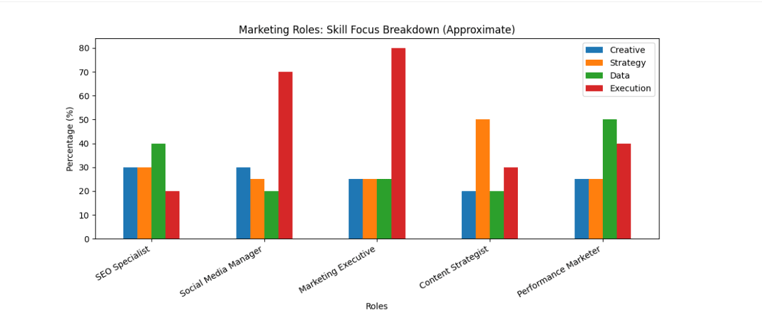
figure: What Marketing Roles Actually Look Like (Skill Breakdown)
This chart breaks down the real skill mix behind each role, because job titles rarely tell the full story.
What I’m Realizing About Marketing Roles
The more I learn, the more I realize something simple but important:
Marketing roles are not separate worlds. They overlap a lot.
- SEO feeds content
- Content feeds social media
- Social media feeds ads
- Ads generate data
- Data feeds strategy
It’s all connected.
And no matter the role, one thing always matters:
Understanding people.
Certifications I’m Currently Exploring (Still Learning)
I believe certifications won’t get you hired on their own, but they help you get your foot in the door.
More importantly, they give you structured knowledge and something tangible to talk about in interviews.
These are the certifications and programs I'm currently exploring and why they stood out to me.
1. Google Digital Marketing & E-commerce (Coursera)
This is the foundation course I'm looking at because it covers the bigger picture of digital marketing.
Instead of focusing on one specific skill, it introduces concepts like digital channels, customer journeys, e-commerce, analytics, and online marketing fundamentals.
For someone who's still figuring out where they want to specialize, it seems like a good starting point.
2. HubSpot Social Media Marketing
Duration: Approximately 5 hours plus an exam
This is one of the first certifications I wanted to complete because social media marketing is often misunderstood.
The course goes beyond simply posting content. It covers audience building, social media strategy, content planning, and measuring results.
What I like about it is that it teaches the thinking behind social media, not just the tools.
It's also a certification that appears frequently on LinkedIn profiles and is recognized by recruiters.
3. HubSpot Content Marketing
Duration: Approximately 8 hours plus an exam
This certification focuses on how content fits into a larger marketing strategy.
Before learning about marketing, I thought content creation was simply writing blog posts or posting on social media.
Now I'm beginning to understand that good content is connected to business goals, customer journeys, and brand positioning.
This course explores content planning, storytelling, content promotion, and performance measurement.
I see it as a natural follow-up to the social media certification because the two topics complement each other.
4. SEO Certifications: HubSpot SEO + Semrush SEO
Search Engine Optimization was one of the areas that felt intimidating at first because there are so many technical terms.
After researching, I found that combining HubSpot SEO and Semrush SEO seems to be one of the best beginner-friendly approaches.
HubSpot SEO focuses more on the strategy and theory behind search engines.
Semrush SEO Certification is usually around 3 to 4 hours and focuses more on practical SEO tools and workflows.
Together, they provide both the "why" and the "how" of SEO.
5. Google Analytics 4 (GA4)
Duration: Approximately 5 hours of preparation plus a 75-minute exam
Out of all the certifications I've researched, this might be one of the most valuable.
What surprised me is that it's completely free through Google Skillshop.
The certification consists of 50 questions, requires an 80% passing score, and remains valid for 12 months.
Many marketing roles mention analytics, reporting, and data interpretation, yet not many graduates seem comfortable with GA4.
That gap creates an opportunity for beginners who invest time in learning it.
The more I explore marketing roles, the more I realize that understanding data isn't optional anymore.
6. Meta Blueprint
As I started researching performance marketing, Meta Blueprint kept appearing in job descriptions and career advice.
Meta offers several certification paths, but two that caught my attention are:
Unlike some beginner certifications that can be completed within a few hours, Meta Blueprint usually requires more time and preparation.
However, it's highly relevant for anyone interested in paid advertising, performance marketing, or agency work.
Many marketers consider it one of the most respected certifications for social advertising.
7. A Burmese Resource I Recently Discovered
For anyone from Myanmar who prefers learning in Burmese, I also came across Nan Oo Marketing, founded by Burmese marketer Nan Oo.
Besides marketing content, he has also built an online learning platform called "Futura School" that offers a Full Stack Marketing program.
The program isn't free, but from what I've researched, it covers practical topics such as:
- Website and CMS management
- SEO fundamentals
- Google Tag Manager & Analytics Course
The program lasts around three to six months and costs approximately USD 80, which seems quite accessible compared to many international marketing bootcamps.
As someone who understands Burmese, it's encouraging to see educational resources like this being built specifically for Myanmar learners.
If I Were Building My Learning Roadmap Today
Rather than taking everything at once, I'd focus on building skills layer by layer:
- HubSpot Social Media Marketing - strategy
- HubSpot Content Marketing - content systems
- HubSpot SEO + Semrush SEO - visibility
- Google Analytics 4 - data and measurement
- Meta Blueprint - paid advertising
That sequence feels logical to me because each step builds on the previous one.
You learn how marketing works first, then how content works, then how people discover content, then how to measure results, and finally how to scale growth through advertising.
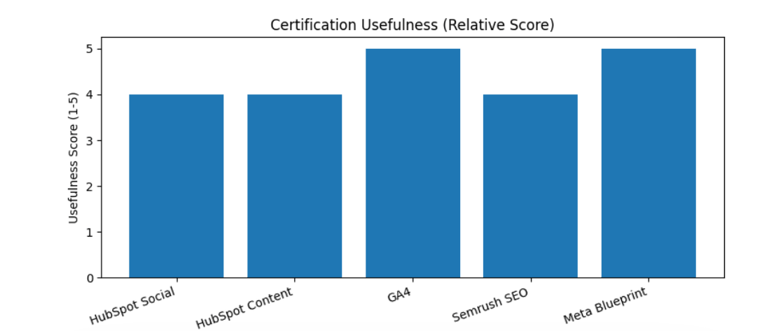
figure: This chart shows a simple relative usefulness score (1–5) based on real-world job relevance.
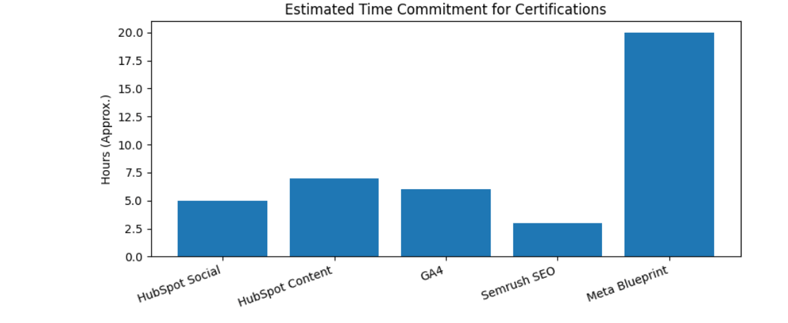
figure: This chart shows how much time each certification typically takes.
Final Thoughts
As someone who's still learning, one of the biggest lessons I've taken away is that it's okay not to know everything yet.
Marketing is a field that constantly evolves. New platforms emerge, algorithms change, trends come and go, and even experienced marketers continue learning throughout their careers.
Right now, my goal isn't to become an expert overnight.
My goal is to build a strong foundation, stay curious, and keep learning one step at a time.
Whether that's completing a certification, experimenting with a small project, analyzing a campaign, or simply learning a new concept, every step adds up.
If you're also a student, career switcher, or beginner trying to understand where you fit in marketing, I hope this article helps make the landscape feel a little less overwhelming.
You don't need to master everything at once.
Start with one area that interests you, learn the fundamentals, apply what you learn, and keep building from there.
After all, every marketer starts somewhere.
This is simply where my journey begins.